What "idea validation" actually means in 2026
Before the list, it helps to separate validation from the thing most tools sell, which is idea scoring.
There are really four steps to validating an idea, and they happen roughly in this order:
Desk research — what's the market, who already serves it, and what are real people complaining about right now? Done well, this is grounded in actual community discussions and sources you can check — not an AI's vibe.
Shaping the solution — pressure-testing the idea against that research and shaping a solution that fits the problem. Is the problem real and painful? Is your angle different? What would have to be true for this to work? This is where a tool that only flatters you is worse than useless.
Talking to real people — the step almost every tool skips. Pulling a few pain-point quotes off Reddit is a starting point, not a finish line. You validate demand by reaching out, having conversations, and listening.
Shipping something — a landing page, a waitlist, a scrappy MVP. The truest signal is someone giving you their email, their time, or their money.
Most tools in this category stop at step 1 and pretend it's step 4. That's the core problem with the category — and the main reason the tools below rank the way they do.
A quick note on the "accuracy %" you'll see elsewhere: several validation tools advertise a precise accuracy figure ("89% accurate," etc.). Be skeptical. There is no agreed-upon way to measure whether an idea-validation report was "correct," because most validated ideas are never built and most built ideas are changed beyond recognition along the way. A confident percentage is a marketing number, not a measured one. We don't use them here.
# | Tool | What it actually does | Where it stops | Free tier | Best for |
|---|
1 | Buildpad | Validates demand with deep multi-agent research, then builds a personalized roadmap from your idea to a launched business | Doesn't stop at a report — keeps going through interviews, MVP, and launch | Yes | Founders who want real validation and a partner to build with |
2 | Validator AI | Conversational AI that scores your idea and gives advice | Stops at AI opinion; tends toward encouragement | Yes | Talking an early idea out loud |
3 | IdeaProof | Multi-model AI report: market sizing, SWOT, competitors | Stops at the generated report | Yes | A fast, broad first-pass document |
4 | Google Trends | Shows whether search interest in your space is rising or falling | Search demand only — no "why" | Yes (free) | A 60-second demand sanity check |
5 | Product Hunt | Puts a launch in front of an early-adopter audience | Only useful once you have something to show | Yes (free) | Real reactions at launch |
6 | Reddit | The raw, unfiltered source of real pain points and demand | You do all the work manually | Yes (free) | Reading what your market actually says |
Below, each one in detail — including the honest limitations.
1. Buildpad — the best alternative for true validation
Type: Idea validation → full build (from idea to launch and beyond)
Free tier: Yes
Site: buildpad.io
If you want to find out whether your idea truly has demand, Buildpad simply outperforms everything else on this list.
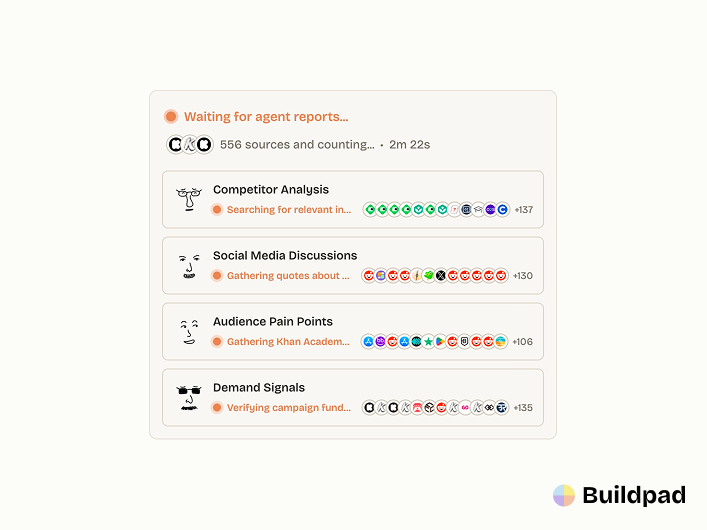
Instead of a single AI grading a short description of your idea, Buildpad begins by getting a deep understanding of your idea and then sending out multiple AI agents working in parallel to research the market. Each one going deep on a different slice of your market: what real people complain about in online communities, current solutions, gaps in the market, and more. Every finding links back to a source you can check. The result is closer to a research team than a chatbot.
It's also critical on purpose. Your idea to sell hats for ducks will not be met with "Amazing idea!". A validator that flatters you is worse than none at all, because it sends you off to build the wrong thing with false confidence.
But here's what actually separates Buildpad from every other entry on this page: it doesn't hand you a report and walk away.
After the initial market research, the AI will guide you step by step through turning your idea into a real company. It takes you through a roadmap beginning from where you are today and leading to where you want to go.
The AI has access to tools toa simplify the journey for you, like the agent interview: AI conducts a voice interview with your potential customers, then helps you analyze what they said to determine if demand exists. It turns the most intimidating, most-skipped part of validation into something you'll actually do.
So idea validation isn't where Buildpad stops — it's phase one. From a validated idea, the same cofounder keeps going with you: talking to real people, shipping a simple first product, iterating on feedback, and launching an actual business. That's the difference between a tool you use once and a partner you build with.
It shows in what founders say it got them to — outcomes, not reports:
"We followed the steps on Buildpad, and now we have paying customers for an app we're passionate about." — Ace Apolonio, Founder, Mindleaf
Used by 100,000+ founders, it's the most-adopted platform in the space.
Strengths
The deepest demand validation on this list: parallel multi-agent research, fully cited
Built to be honest and critical, not encouraging-by-default
Generates a personalized, phase-by-phase roadmap from your idea to a launched business
Agent interviews automate the step everyone skips — real voice conversations with customers, analyzed for you
Most-adopted platform in the category (100,000+ founders), free to start
Limitations
It's a guided cofounder, not a one-click score — if you only want a single throwaway number in 90 seconds and nothing else, it's more than that
The depth rewards founders who actually want to build, not just window-shop an idea
Best for: Founders who want to validate demand properly and have a partner that takes them from a validated idea all the way to a launched business.
2. Validator AI — conversational scoring for an early gut-check
Type: AI scoring (conversational)
Free tier: Yes
Validator AI is one of the longer-running tools in the space and leans on a conversational format: you talk through your idea with an AI advisor, it researches in the moment, gives you a startup score, and follows up with advice. It has a large user base, and the talk-it-out format is genuinely nice when an idea is still fuzzy in your head.
The catch — and this comes up repeatedly in independent comparisons — is that it skews encouraging. It has a reputation for telling founders their ideas are promising. That's pleasant and motivating, but it's the opposite of what validation is supposed to do. A second opinion only helps if it's willing to tell you no.
Strengths
Conversational, low-friction way to think an idea out loud
Large, established community
Generous free access for basic use
Limitations
Tends toward encouragement over honest, critical feedback
Output is AI opinion — no real demand evidence or customer contact
Stops at the score and some follow-up advice
Best for: Founders who want to verbalize a raw idea and get a quick, friendly first reaction — paired with something more critical afterward.
3. IdeaProof — a fast, broad first-pass report
Type: AI scoring (multi-model)
Free tier: Yes
IdeaProof generates a wide-ranging report quickly — market sizing, a competitor SWOT, risk notes, and add-ons like business-plan and brand generation. If what you want is a tidy document covering a lot of ground in one pass, it delivers that, and the free tier lets you try it without much commitment.
Two honest caveats. First, treat the headline "accuracy" claims as marketing rather than measurement, for the reasons covered above. Second — and this is the structural limitation of the whole report-generator format — a generated document is still an AI's read of your one-paragraph description. It's a starting artifact, not validation. Nobody confirmed they'd pay.
Strengths
Fast, broad first-pass report across several dimensions
Extra generators (business plan, brand assets) in one place
Free tier to try it
Limitations
Advertised "accuracy" figures aren't independently measurable
Output is a generated document, not demand evidence
No customer contact and no path past the report itself
Best for: Founders who want a quick, broad document to react to early on — with the understanding that the real validation work still comes after.
4. Google Trends — the free demand sanity check
Type: Demand signal (search)
Free
Before any paid tool, spend sixty seconds here. Google Trends shows whether search interest in your space is climbing, flat, or quietly dying. It won't tell you why, and it can't see demand that nobody searches for yet — but a falling trend line is a cheap, early warning, and a rising one is a small point of real evidence. It's free, fast, and there's no reason to skip it.
Strengths
Limitations
Search interest only — no context, no "why," no people
Blind to brand-new categories with no search history
One signal among many, not a verdict
Best for: A fast, free reality check on whether interest in your space is going up or down.
5. Product Hunt — real reactions when you have something to show
Type: Customer signal (launch)
Free
Validation eventually requires putting something real in front of real people, and Product Hunt is one of the best places to do it. An early-adopter audience will tell you — through upvotes, comments, and signups — whether your thing resonates. The honest limitation is timing: it's only useful after you have a landing page or MVP, so it belongs near the end of the process, not the start.
Strengths
Limitations
Only relevant once you have something to show
The audience skews tech/early-adopter, which may not be your market
A launch is a moment, not ongoing demand validation
Best for: Getting genuine market reactions at the point you're ready to show something.
Type: Demand signal (community)
Free
Here's a secret: a lot of "AI validation" is just summarizing Reddit. You can go straight to the source. Find the subreddits where your future customers complain, and read — actually read — what frustrates them, in their own words. It's unfiltered, it's free, and it's where genuine pain points live before any tool repackages them.
The trade-off is effort: you're doing the searching, reading, and synthesizing yourself, with no structure. (This is exactly the manual work Buildpad automates with its community research — but doing it by hand at least once is a good way to learn what real demand sounds like.)
Strengths
The unfiltered, original source of real complaints and requests
Free and enormous in coverage
You can talk to people directly in the threads
Limitations
Entirely manual — no structure, scoring, or synthesis
Easy to cherry-pick quotes that confirm what you hoped
Time-consuming to do thoroughly
Best for: Founders who want to hear their market in its own words before trusting any tool's summary of it.
The space is crowded, and a few other names come up in roundups: Preuve AI (evidence-based, source-linked reports), WorthBuild (validation bundled with customer-discovery leads), Trend Seeker (demand-matching against a database of community requests), plus VenturusAI and FounderPal (framework generation and brainstorming, respectively). Each does a narrow slice reasonably well. They share the same ceiling as the scoring tools above, though: they hand you an analysis and leave the real validation — the conversations and the building — to you.
It depends on what you're really trying to do.
You want to validate properly and keep going to a real business. Use Buildpad. It validates demand deeper than anything else here, then builds you a personalized roadmap and works through it with you — interviews, MVP, launch — instead of leaving you with a report.
You just want to think a raw idea out loud. Validator AI is a friendly place to verbalize it — just pair it with something more critical, because it leans encouraging.
You want a broad first-pass document fast. IdeaProof generates one quickly. Treat it as a starting artifact, not a verdict.
You want free, instant signals. Google Trends for search demand and Reddit for raw pain points cost nothing and take minutes. Product Hunt comes later, when you've got something to launch.
The mistake to avoid is the one the whole category quietly encourages: mistaking a score for validation. A number on a report is a hypothesis. Validation is what happens when real people respond to something real. Pick the tool that gets you to that — not the one that gets you to a verdict the fastest.
Frequently asked questions
What's the difference between idea validation and idea scoring? Scoring is an AI reading your idea description and grading it — fast, but it's an opinion about a paragraph. Validation is evidence that real people want what you're building: demand signals, direct conversations, and real responses to something you've put in front of them. Most "validation tools" only do scoring. The full process — research, critical analysis, customer conversations, and an MVP — is what actually validates an idea, and it's what Buildpad is built around.
Are AI idea validation tools accurate? Be careful with the word "accurate." Some tools advertise a precise accuracy percentage, but there's no agreed way to measure whether an idea-validation report was "right" — most validated ideas are never built, and most built ideas change drastically. Treat any headline accuracy figure as marketing. What's genuinely useful is research grounded in real sources and real customer feedback, not a confident-looking number.
Can I validate a business idea for free? Yes — at least the first pass. Google Trends, Reddit, and Product Hunt are free and cover demand signals, real pain points, and launch reactions. Tools like Buildpad also offer free access to start the guided process. The most expensive thing in validation isn't a tool — it's the months spent building something nobody wanted because you skipped it.
What's the most important step in validating an idea? Talking to real people. Desk research and AI analysis can tell you a problem might exist; only the people with the problem can confirm they'd pay to solve it. This is the step nearly every scoring tool skips — and the one Buildpad makes easy with agent interviews, where the AI runs voice interviews with your respondents and helps you analyze what they said.
Do I need more than one validation tool? Often, if you're stitching together point tools — one for trends, one for community signal, one for launch. The alternative is a single tool that doesn't stop at validation: Buildpad validates demand, then generates a personalized roadmap and works through it with you, phase by phase, from validated idea to launched business — rather than handing you four disconnected steps to manage yourself.
The bottom line
The best idea validation tools in 2026 aren't the ones that grade your idea the fastest. They're the ones that move you closer to the only proof that counts — real people, choosing your thing.
By that standard, the point tools each cover a slice: Google Trends and Reddit for cheap early signal, Product Hunt for launch reactions, Validator AI and IdeaProof for an early gut-check. And Buildpad covers the whole journey — validating demand with cited multi-agent research, running real voice interviews with your customers, thinking critically instead of flattering you, then mapping and walking the path from a validated idea to a launched business.
Validate before you build. Then build something people actually want.